The Yards at Bozburun
Where the gulets are still built by hand. A working town that explains the boats and the coast in equal measure.
If you've spent a week on a Turkish charter, you've probably been on a gulet. The wooden hull with two masts and a wide stern, the cabins below the deck line, the cushioned bow for lounging - that's a gulet. The form is roughly two hundred years old. The name comes from the Turkish gulet, itself probably derived from the French goélette, a small sailing vessel. The boats themselves come from this stretch of the southern Turkish coast and have done since well before anyone was running them as charters.
Most gulets are built in three places on the Aegean. The biggest yards are at Bodrum - Europe's largest wooden yacht shipyard, by output. Marmaris has yards, mostly working on smaller vessels and refits. And Bozburun, on its own peninsula east of Marmaris, has yards that have been making gulets in something close to the same way for several generations.
Bozburun is the one most charter buyers haven't heard of. The town itself is small - three or four streets, a quay with restaurants along it, a couple of small hotels. The road there from Marmaris is winding and slow; in summer it takes ninety minutes for what looks like forty kilometres on a map. The peninsula is mostly working anchorages and small villages. The town's economy is built on three things: tourism in season, fishing year-round, and the boats.
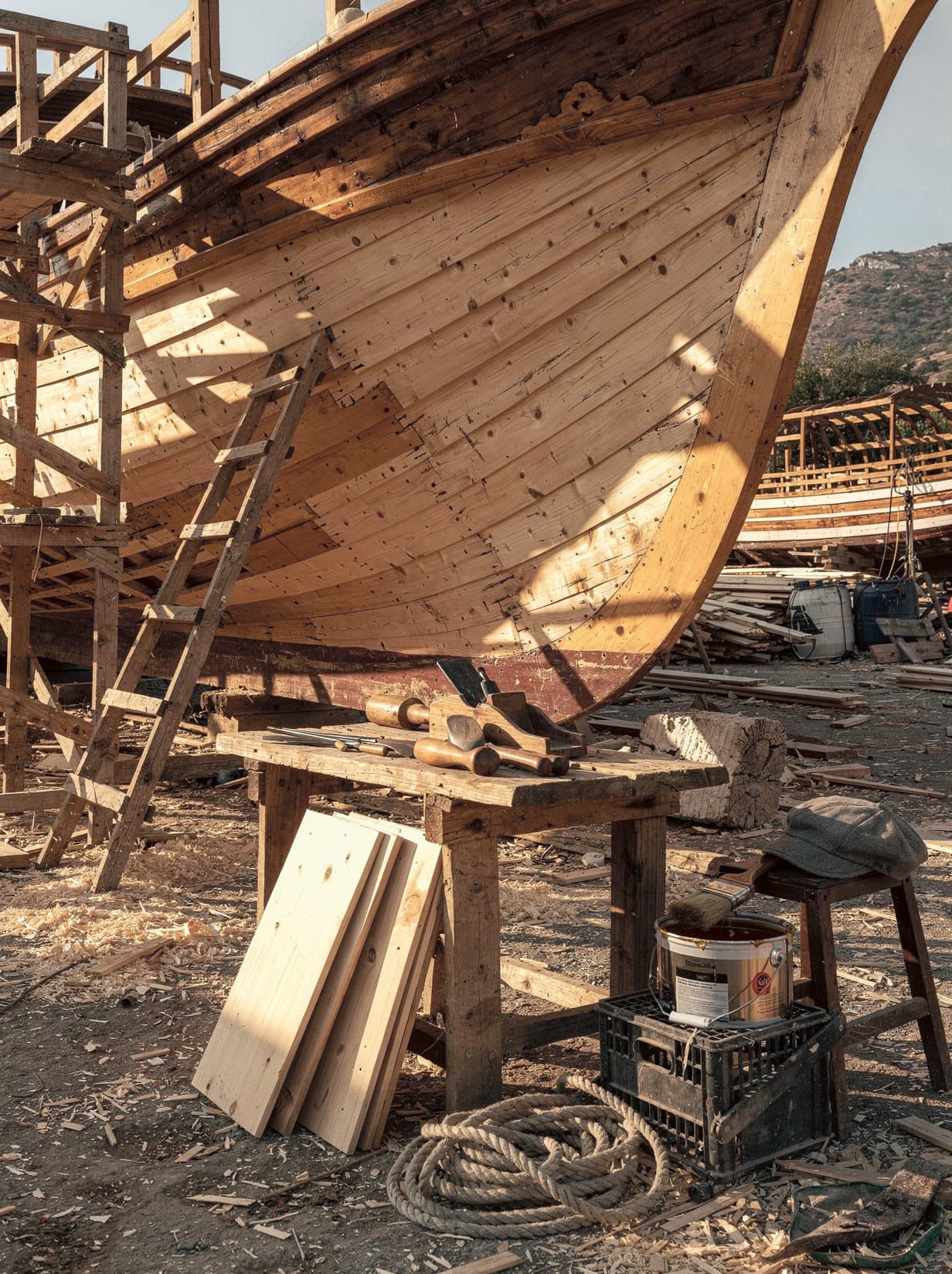
The boatyards sit at the edges of the town, along the waterfront where the slipways meet the bay. There are perhaps a dozen of them at any time, some specialising in new builds, others in refits and maintenance. From the road you can usually see two or three hulls in progress - the bare wooden skeleton of a new gulet, sometimes with workers around it, sometimes empty for the day. The boats sit upright on supports, twenty or thirty metres long, the ribs of the hull exposed before planking goes on.
The building process is slow. A standard gulet takes between nine and eighteen months to complete, depending on size and complexity. The hull is built first, plank by plank, fitted to a frame of ribs that have been steam-bent into shape. The wood is local pine, sometimes oak for the keel and the harder-stressed parts. The planking is done by hand - there are power tools, but the shaping of each plank to the curve of the hull is something done by eye and feel, by craftsmen who learned from their fathers and grandfathers. After the planking comes the caulking, the painting, the rigging, the interior fit-out. Most gulets are built to specification for a particular owner; the larger commercial yards work to a few standard sizes, and finishing details vary by buyer.
The men who do this work are mostly second- or third-generation. Some of the older craftsmen in the Bozburun yards have been building gulets for thirty or forty years and started apprenticing as teenagers. The trade has changed in ways and not changed in others. CAD drawings have replaced hand sketches at the design stage. Power tools have replaced some of the hand work. But the fundamental craft - the shaping of wood to curve, the fitting of one plank to the next, the slow weeks of caulking the seams - is essentially the same work it was fifty years ago.
What's different now is the demand. The charter market has grown over the past three decades, which has meant steady work for the yards. A new boat for a charter operator, a refit every five or six years, occasional rebuilds of vessels that have hit hard weather or run aground. Bozburun in particular has held onto its craft tradition partly because the work has stayed steady. The bigger yards at Bodrum produce more boats faster, but the Bozburun yards have kept the slower pace and the older methods.
The town reflects the work. The quayside restaurants are the kind where the boat owners eat with the men who built their boats - small places, mostly family-run, doing meze and grilled fish and lamb. There's no chain anywhere on the peninsula. The hotels are small. The shops sell what working people need rather than what tourists want. In high summer the town has a steady flow of charter guests stopping for an evening before moving on; for most of the year it's quiet.
This is also a useful place to anchor. Boats coming through the Gulf of Hisarönü from Marmaris will often stop in Bozburun for a night, sometimes for two if the wind is wrong for continuing. The harbour is sheltered, the restaurants are good, and there's something genuinely interesting about being in a place that exists to make the boats you're on.
The peninsula around the town is some of the best anchoring on the Turkish coast. South of the town, the road runs out at Serçe and the bays beyond - Bozukkale, Dirsekbükü - are reached only by sea. These are some of the quietest anchorages on the whole coast, partly because the road doesn't reach them and partly because they're far enough from the busy gulfs that most charter weeks don't include them. We tend to send charters from Marmaris through this section of the peninsula. If you have a week from Marmaris and want to see the quieter side of the coast, working down the Bozburun peninsula and into the bays beyond Serçe is the route we'd suggest.
The point about the yards isn't that you should visit them. Most visitors who want to see boats being built can do that from the road; the yards aren't tourist sites, and the workers there have things to do. The point is that the gulet you're chartering came from a place like this - built by hand, over months, by people whose families have been doing this for a long time. The form has roots. The boats have provenance. The coast and the boats explain each other.
When you anchor for the night in a bay that the road doesn't reach, on a wooden boat that was hand-built six hours away, those two things sit together. The coast is what it is partly because of how it's been worked, including the building of these boats. The boats are what they are partly because of where they were built. It's hard to explain it any better than that.